
Levantine Commercial Alliance (LCA)
Cross-Border Trade & Strategic Partnerships
Regional Connectivity • Trade Integration • Long-Term Commercial Relationships
LCA Overview
The Levantine Commercial Alliance (LCA) represents the regional trade and commercial connectivity environment within the Phoenix–Velixon Ecosystem.
The alliance was established to support long-standing business relationships, cross-border coordination, logistics-linked commercial activity, transportation-oriented operations, customs-connected environments, and strategic partnerships across interconnected regional markets.
Its structure reflects the ecosystem’s recognition that regional commercial activity within the Levant and surrounding markets is often shaped not only by operational capability, but also by:
- Continuity,
- Relationship networks,
- Logistical familiarity,
- Commercial trust,
- And long-term market connectivity.
The alliance gradually evolved through years of interaction between participating environments involved in:
- Transportation,
- Customs clearance,
- Freight coordination,
- Regional commerce,
- Operational logistics,
- And cross-border business activity.
Its structure became increasingly organized through the development of Jo-T-Hub.com — Jordan Trade Hub — which introduced a more scalable and connectivity-oriented framework for regional commercial interaction and strategic trade participation.
Today, LCA functions as a specialized alliance platform focused on:
- Regional trade integration,
- Commercial connectivity,
- Logistics-oriented coordination,
- Strategic partnerships,
- Transportation-linked participation,
- And relationship-driven market engagement across multiple jurisdictions.
Unlike purely transactional commercial environments, the alliance operates through long-term relationship continuity and regionally connected operational participation.
Strategic Role Within the Ecosystem
Within the broader Phoenix–Velixon Ecosystem architecture, LCA serves as the ecosystem’s regional commercial connectivity and trade-oriented coordination environment.
Its role includes:
- Supporting cross-border commercial interaction,
- Strengthening logistics-linked operational coordination,
- Facilitating trade-oriented collaboration,
- And aligning participating environments involved in regionally connected commercial activity.
LCA also acts as an important bridge between:
- Logistics ecosystems,
- Transportation environments,
- Customs-related participation,
- Regional commercial operations,
- And strategic partnership networks.
Many ecosystem initiatives naturally intersect with:
- Freight coordination,
- Transportation support,
- Customs procedures,
- Logistics operations,
- Regional commerce,
- And long-term operational connectivity across multiple markets.
The alliance was developed to provide a flexible coordination environment capable of supporting these interconnected regional realities while preserving independent participation structures and relationship-oriented operational collaboration.
Unlike implementation-oriented or digitally focused consortium platforms, LCA operates closer to:
- Regional connectivity,
- Commercial continuity,
- Logistics-oriented coordination,
- And long-term relationship ecosystems.
This creates a commercially grounded and regionally integrated operational identity within the broader ecosystem architecture.
Find out more details below
Core Focus Areas
LCA focuses on areas connected to:
- Regional trade,
- Transportation-linked commercial activity,
- Customs-related operational environments,
- Logistics coordination,
- Strategic partnerships,
- Freight-oriented participation,
- And cross-border commercial integration.
Its operational structure supports activities such as:
- Trade-oriented coordination,
- Logistics-linked collaboration,
- Transportation support,
- Regional market engagement,
- Strategic partnership development,
- And relationship-driven commercial interaction.
The alliance also supports broader ecosystem initiatives requiring:
- Multi-market operational coordination,
- Logistics accessibility,
- Transportation integration,
- And commercially connected regional participation.
Regional Commercial Connectivity
One of the defining characteristics of LCA is its emphasis on continuity and long-term commercial relationships.
The alliance was developed around operational environments where:
- Relationships,
- Logistical familiarity,
- Customs experience,
- Transportation coordination,
- And regional trust networks
Often play a central role in successful commercial activity.
Rather than operating through isolated transactional interaction, LCA supports:
- Relationship-driven coordination,
- Commercially connected participation,
- And regionally integrated operational collaboration.
This allows participating environments to maintain:
- Stronger commercial continuity,
- Broader operational connectivity,
- And more adaptable regional engagement across evolving market conditions.
The alliance’s structure reflects the commercial realities of interconnected regional markets where practical coordination and long-term familiarity often remain essential operational advantages.
Strategic Coordination
The Levantine Commercial Alliance is strategically coordinated by:
- Abdulla Miqdadi
- Yazan Zaza
- Bassem Al-Yassin
This coordination structure combines:
- Ecosystem strategic development,
- International commercial engagement,
- Regional logistics connectivity,
- Transportation-oriented operational understanding,
- And long-standing cross-border business experience.
The alliance reflects a relationship-oriented coordination model built around regional familiarity, operational continuity, and commercially integrated participation across multiple sectors and jurisdictions.
Participating Founder-Aligned Environments
Founder-aligned participating environments connected to LCA include:
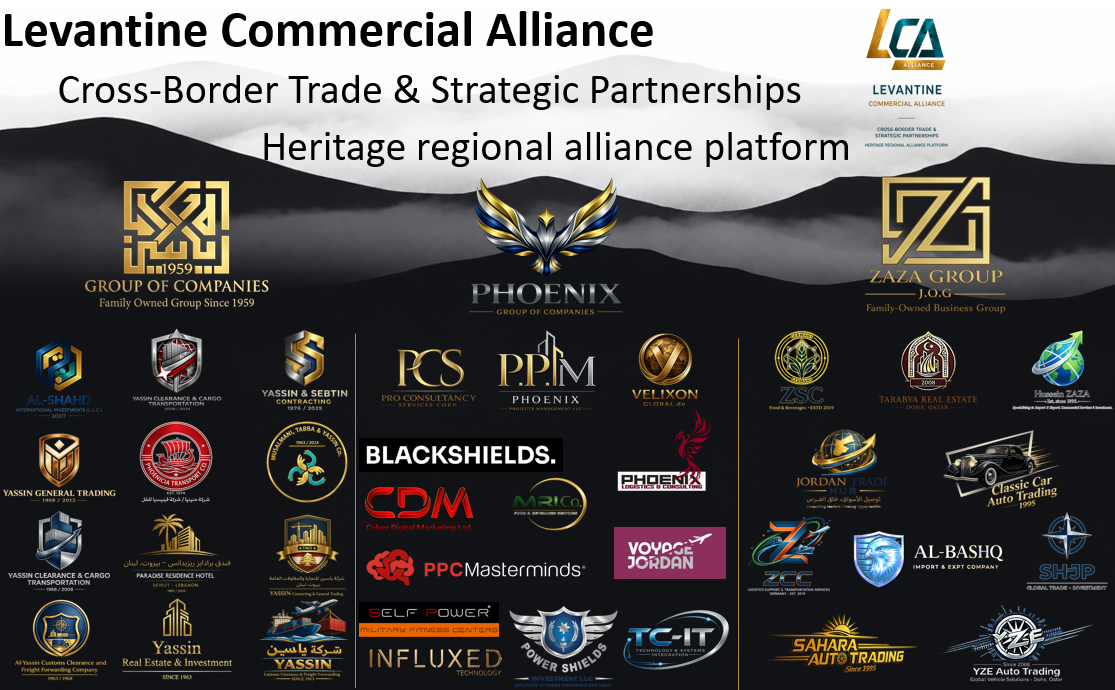
- PCS – Pro Consultancy Services Co.
- M.R.I.Co.
- Phoenix Logistics Services & Management Consulting LTD
- PPC Masterminds Corp. USA
- Culver Digital Marketing LTD
- Voyage Jordan
- PowerShields Investment LTD
- Self Power Limited
- Influxed Technology Co.
- Phoenix Projects Management LTD (PPM)
- BlackShields Commercial Services LTD
These participating environments contribute capabilities connected to:
- Logistics coordination,
- Consulting,
- Strategic development,
- Infrastructure-linked participation,
- Operational commerce,
- Digital connectivity,
- And internationally connected business environments.
Their combined participation strengthens the alliance’s ability to support integrated regional commercial activity across multiple operational sectors.
European Interface Participation
The alliance also includes participation from:
- Velixon Global.de (Germany)
Velixon Global.de functions as a Germany-based commercial coordination and international interface environment connected to the broader ecosystem through representation and strategic coordination arrangements.
Its inclusion within LCA strengthens:
- European commercial connectivity,
- Cross-border coordination,
- International relationship development,
- And broader regional-to-international engagement capability.
This contributes to the alliance’s broader objective of connecting regional operational environments with international commercial interaction.
Zaza Group Participation Environment
Aligned participating environments connected to the Zaza Group include:
- SH-JP Company
- Sahara Auto Trading
- Classic Car Auto Trading
- Al-Bashq Company
- YZE Auto Trading (Qatar)
- Tarabya Real Estate Company (Qatar)
- ZCC GmbH (Germany)
- ZSC GmbH (Germany)
- Jo-T-Hub.com (Joint Partnership)
These participating environments contribute operational and commercial experience connected to:
- Automotive trade,
- Regional commerce,
- Logistics coordination,
- Transportation-linked participation,
- Real estate activity,
- Germany-based operations,
- And cross-border commercial interaction.
Their participation strengthens the alliance’s regional adaptability and broader international connectivity.
Al-Yassin Group Participation Environment
Aligned participating environments connected to the Al-Yassin Group include:
- Yassin Customs Clearance & Freight Co. (1)
- Musallamani, Taba’a & Yassin Co.
- Yassin General Trading & Contracting Co.
- Paradise Residence Hotel
- Yassin Customs Clearance & Freight Co. (2)
- Yassin General Trading Co.
- Haninya Co. / Phoenicia Transport Co.
- Yassin & Sebastian Contracting Co.
- Al-Shahd International Investments L.L.C.
- Yassin Customs Clearance & Freight Co. (3)
These participating environments contribute extensive operational experience connected to:
- Customs clearance,
- Freight coordination,
- Transportation operations,
- Regional trade,
- Contracting activities,
- Hospitality environments,
- And long-standing logistics-oriented commercial activity across interconnected regional markets.
Their inclusion significantly strengthens the alliance’s:
- Logistics accessibility,
- Transportation coordination capability,
- Regional commercial familiarity,
And cross-border operational continuity.
Jo-T-Hub & Commercial Accessibility
Jo-T-Hub.com represents an important commercial accessibility layer within LCA.
As a joint partnership initiative, it contributes to:
- Business connectivity,
- Regional commercial accessibility,
- Trade-oriented coordination,
- Strategic introductions,
- And scalable market engagement across multiple sectors.
Its role aligns naturally with the alliance’s broader objective of supporting more connected and commercially integrated regional participation environments.
Operational Philosophy
LCA operates through a relationship-oriented participation philosophy built around:
- Regional continuity,
- Operational familiarity,
- Commercial connectivity,
- And long-term strategic collaboration.
Participating environments remain:
- Independently operated,
- Commercially autonomous,
- And legally separate.
The alliance itself functions as:
- A regional coordination environment,
- A commercial connectivity framework,
- And a strategic partnership platform.
This allows participants to:
- Cooperate selectively,
- Support cross-border commercial initiatives,
- And contribute dynamically across evolving regional markets
Without centralized operational consolidation.
The alliance’s flexibility remains one of its strongest structural characteristics within relationship-driven regional commercial environments.
Distinctive Characteristics
LCA’s strength comes from its ability to combine:
- Logistics-oriented operational environments,
- Transportation-linked participation,
- Customs-related experience,
- Regional commercial familiarity,
- Strategic relationship networks,
- And cross-border coordination capability
Within a flexible and commercially connected alliance framework.
Unlike purely transactional trade environments, the alliance benefits from:
- Long-term operational continuity,
- Established regional relationships,
- Practical market understanding,
- And diversified participation environments across multiple sectors and jurisdictions.
This creates a more resilient and adaptable coordination environment capable of supporting:
- Regional trade participation,
- Transportation-oriented operational activity,
- Logistics-linked collaboration,
- And scalable commercial connectivity across evolving regional markets.
Long-Term Direction
As regional markets continue becoming more interconnected through transportation, logistics, trade integration, and cross-border commercial activity, LCA is expected to play an increasingly important role within the Phoenix–Velixon Ecosystem.
Its long-term direction remains focused on:
- Strengthening regional commercial connectivity,
- Supporting logistics-oriented coordination environments,
- Expanding strategic partnership participation,
- And facilitating scalable cross-border interaction across multiple sectors and jurisdictions.
The alliance will continue evolving as a regionally integrated coordination platform while preserving the ecosystem’s alliance-based philosophy, distributed participation structure, and relationship-driven operational foundation.