
Phoenix Group Consortium Institutional Governance Backbone

A Structured Institutional Alliance Architecture
Phoenix Group Consortium serves as the governance backbone of a multi-entity, cross-border ecosystem designed to enable structured cooperation across regulated sectors, sovereign environments, and complex project frameworks.

It does not function as an operating company.

It does not execute projects.

It does not own participating entities.
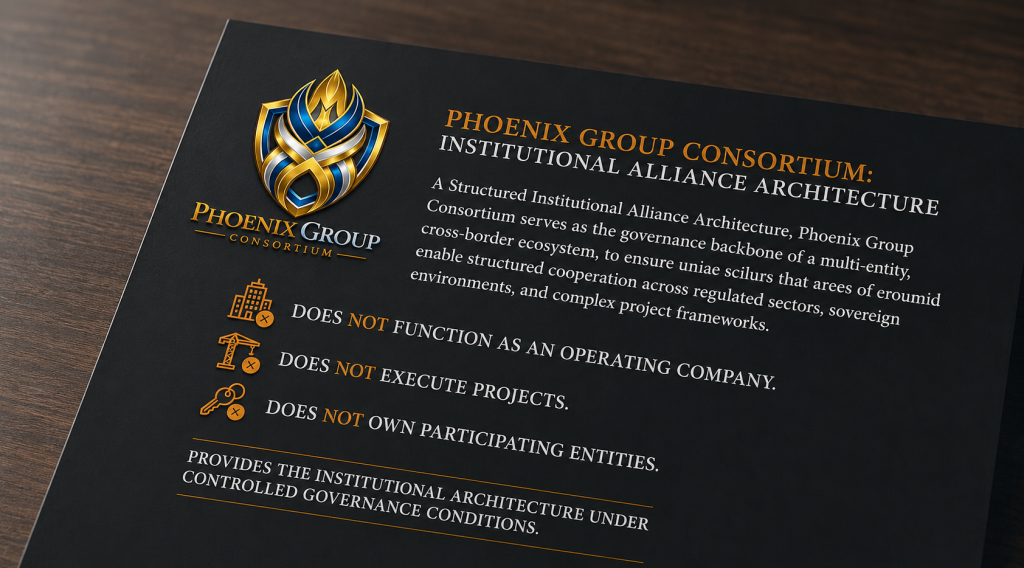
Instead, it provides the institutional architecture through which independent entities align, coordinate, and participate under controlled governance conditions.
Institutional Position
Phoenix Group Consortium exists to:
- Define governance frameworks for multi-entity participation
- Establish clear authority boundaries across participants
- Enable structured cooperation without ownership integration
- Maintain legal separation while supporting coordinated execution
- Provide discipline, clarity, and control in complex environments

What the Consortium Is Not
To ensure clarity of interpretation; Phoenix Group Consortium is not:
- A holding company
- A parent corporation
- A centralized operating platform
- A project execution entity
- An investment vehicle
- A legal authority over participants

All participating entities remain independent in ownership, liability, and decision-making authority.
Core Governance Functions
The Consortium provides structured governance across four key domains:
Participation Architecture
Defines how entities engage within the ecosystem through:
- Project-specific engagement frameworks
- Contractual alignment
- Defined scope participation
Participation Architecture
Defines how entities engage within the ecosystem through:
- Project-specific engagement frameworks
- Contractual alignment
- Defined scope participation
Authority & Control Boundaries
Ensures that:
- No entity represents another without explicit mandate
- No authority is implied through association
- All decision rights originate from formal instruments
Authority & Control Boundaries
Ensures that:
- No entity represents another without explicit mandate
- No authority is implied through association
- All decision rights originate from formal instruments

Operating Principle
Participation within Phoenix Group Consortium is:
- Voluntary
- Contractual
- Context-specific
- Non-permanent
No participation creates:
- Ownership rights
- Control authority
- Financial obligation
- Binding representation

Ecosystem Role
Within the broader Phoenix–Velixon ecosystem; Phoenix Group Consortium functions as:
- The governance layer
- The structural discipline engine
- The institutional coordination backbone
It enables the ecosystem to operate without becoming a centralized entity.

Structural Separation Doctrine
The Consortium strictly maintains:
- Separation between governance and execution
- Separation between entities and authority
- Separation between participation and ownership
This ensures:
- Legal clarity
- Regulatory safety
- Operational flexibility
- Scalable cooperation

How the Ecosystem Operates
Execution does not occur within the Consortium.
All operational activities are carried out by:
- Independent execution entities
- Participating under project-specific contractual frameworks
The Consortium does not intervene in execution.
It only defines the conditions under which execution alignment occurs.

Position Within the Architecture
Phoenix Group Consortium sits at the top of the ecosystem structure as the:
Governance Backbone
Supporting:
Navigation Pathways
From this page, users may proceed to:
- Institutional Architecture & Governance Framework
- Participation & Authority Boundaries
- Capital & Liability Framework
- Representation & Jurisdictional Structure
- Strategic Partners & Ecosystem Participants
- Leadership Architecture

Final Positioning Statement
Phoenix Group Consortium is not an organization in the conventional sense; It is a governance architecture.
A structured institutional framework designed to enable:
- Controlled cooperation
- Independent participation
- Cross-border execution alignment
Without creating:
- Centralized authority
- Ownership consolidation
- Structural dependency