
Section 1 — Institutional Introduction
Phoenix Group Consortium maintains the governance architecture of the Phoenix–Velixon ecosystem.
The ecosystem operates as a distributed coordination architecture designed to support structured collaboration environments between independent entities operating across multiple sectors and jurisdictions.
Rather than functioning as a consolidated corporate structure, the architecture provides a framework through which organizations may explore collaboration contexts while preserving institutional independence, contractual clarity, and regulatory integrity.
Within this architecture, Phoenix Group Consortium maintains the governance backbone responsible for preserving structural discipline, institutional coherence, and architectural clarity.
Operational engagements within the ecosystem arise only through independent entities participating in project-specific contractual frameworks.
Section 2 — Ecosystem Architecture Overview
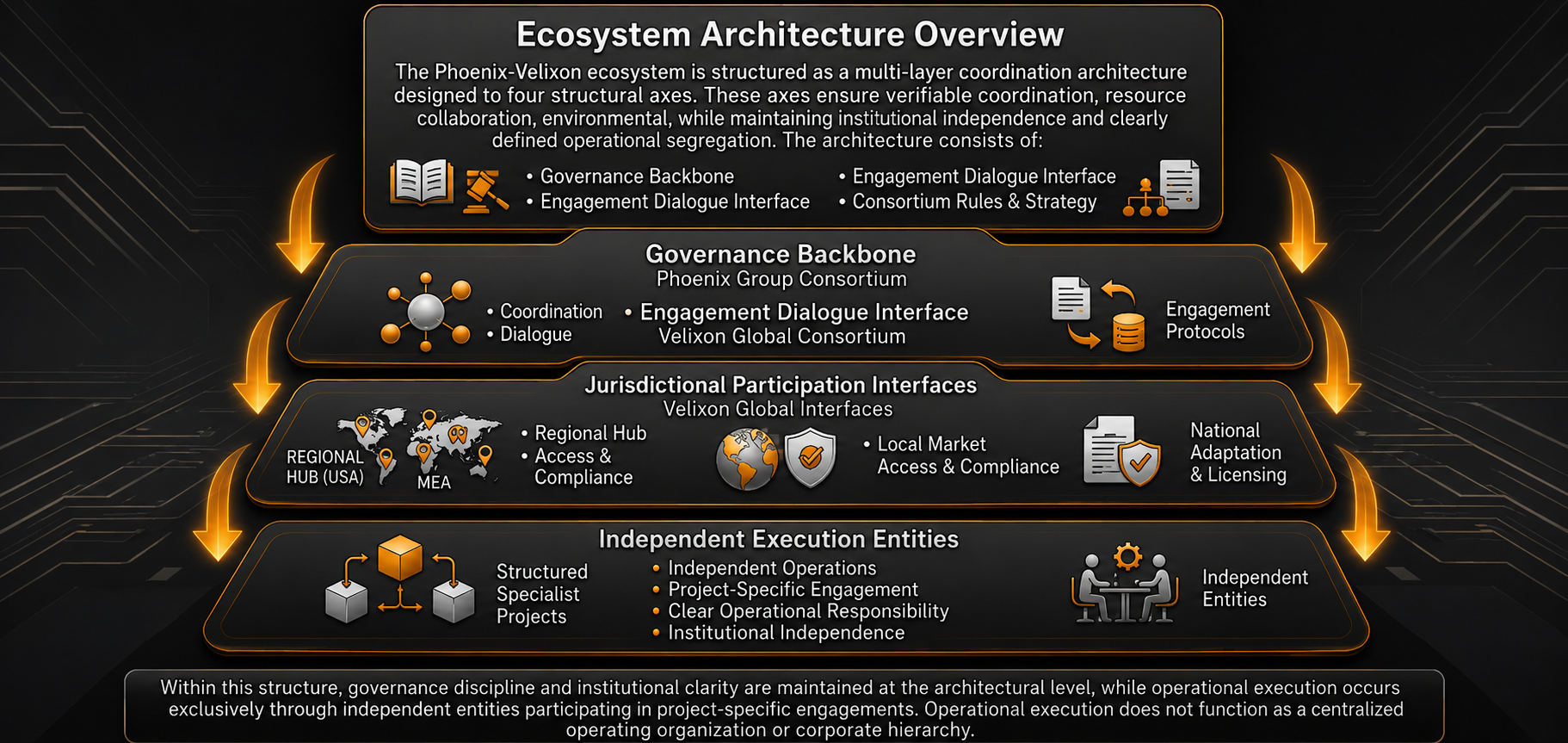
The Phoenix–Velixon ecosystem is structured as a multi-layer coordination architecture composed of four structural layers.
These layers collectively enable organizations to explore collaboration environments while maintaining institutional independence and clearly defined operational responsibilities.
The architecture consists of:
- Governance Backbone
- Engagement Dialogue Interface
- Jurisdictional Participation Interfaces
- Independent Execution Entities
The structural relationship between these layers may be represented as follows:
Phoenix Group Consortium
(Governance Backbone)
↓
Velixon Group Consortium
(Engagement Dialogue Interface)
↓
Velixon Global Interfaces
(Jurisdictional Participation)
↓
Independent Execution Entities
(Project-Specific Engagement)
Within this structure, governance discipline and institutional clarity are maintained at the architectural level, while operational execution occurs exclusively through independent entities participating in project-specific engagements.
Section 3 — Governance Backbone
Phoenix Group Consortium functions as the governance backbone of the ecosystem architecture.
Its role is to preserve the structural integrity of the ecosystem by maintaining governance doctrine, ensuring architectural clarity, and safeguarding the interpretation boundaries that define the ecosystem.
Responsibilities associated with the governance backbone include:
- Maintaining the governance doctrine defining the architecture
- Preserving structural discipline across ecosystem interactions
- Ensuring institutional clarity in ecosystem representation
- Safeguarding interpretation boundaries that prevent structural mischaracterization
Phoenix Group Consortium does not execute operational engagements and does not function as a project execution entity.
Its role is limited to maintaining the governance architecture within which collaboration environments may emerge.
Section 4 — Engagement Dialogue Interface
Velixon Group Consortium functions as the engagement dialogue interface within the ecosystem architecture.
The engagement interface supports structured dialogue environments through which independent organizations may explore potential collaboration contexts across sectors and jurisdictions.
Within these dialogue environments, organizations may examine complementary capabilities, assess potential participation contexts, and explore structured collaboration frameworks.
These environments facilitate disciplined institutional interaction while avoiding the creation of operational commitments or centralized authority.
Velixon does not execute operational engagements and does not function as a project developer, services provider, or intermediary.
Operational engagements arise only when independent entities establish project-specific contractual agreements governing a particular engagement.
Section 5 — Jurisdictional Participation Interfaces
Velixon Global regional platforms provide jurisdictional participation interfaces within the ecosystem architecture.
These regional interfaces support participation environments within specific regulatory and operational jurisdictions.
Organizations operating within regional frameworks may interact through these interfaces to explore collaboration contexts extending across the broader ecosystem architecture.
The jurisdictional participation interfaces allow organizations to examine participation opportunities while operating within their respective regulatory environments.
Velixon Global does not execute operational engagements and does not function as a centralized regional operating authority.
Section 6 — Independent Execution Entities
Operational engagements within the ecosystem architecture occur exclusively through independent entities participating in project-specific contractual frameworks.
These entities remain responsible for:
- Operational execution of specific engagements
- Contractual obligations arising from executed agreements
- Regulatory compliance within the jurisdictions in which they operate
Each participating entity maintains full institutional independence and operational responsibility.
The ecosystem architecture itself does not operate projects, assume operational responsibility, or function as a centralized execution authority.
Section 7 — Structural Integrity of the Architecture
The Phoenix–Velixon ecosystem architecture is designed to preserve institutional clarity and prevent structural misinterpretation.
Structural integrity is maintained through several core principles.
Institutional Independence
All participating entities retain full legal and operational independence.
Liability Segmentation
Operational liabilities remain with the independent entities responsible for executing specific engagements.
Contractual Clarity
Operational commitments arise only through formal contractual agreements between participating entities.
Regulatory Compliance
Entities participating in collaboration environments remain responsible for compliance with applicable regulatory frameworks within their respective jurisdictions.
Through these principles, organizations may interact within structured collaboration environments without creating centralized operational authority or consolidated institutional structures.
Section 8 — Relationship Between the Structural Layers
The structural layers of the ecosystem interact in a complementary manner that preserves both coordination discipline and operational independence.
Within this structure:
- Phoenix Group Consortium maintains the governance architecture and ensures structural discipline.
- Velixon Group Consortium supports engagement dialogue environments through which collaboration contexts may be explored.
- Velixon Global provides jurisdictional participation interfaces that allow organizations operating within regional regulatory frameworks to interact within the ecosystem.
- Independent execution entities undertake operational engagements through project-specific contractual agreements.
This layered architecture enables collaboration environments to emerge across sectors and jurisdictions while preserving institutional independence and clearly defined operational responsibilities.
Section 9 — Link to Governance Doctrine
The structural principles governing the Phoenix–Velixon ecosystem architecture are defined within the Governance Doctrine.
The Governance Doctrine establishes the legal and institutional principles that preserve structural clarity, define institutional roles, and safeguard the interpretation boundaries of the ecosystem architecture.